



Connected to Care: technology to support independent living at home
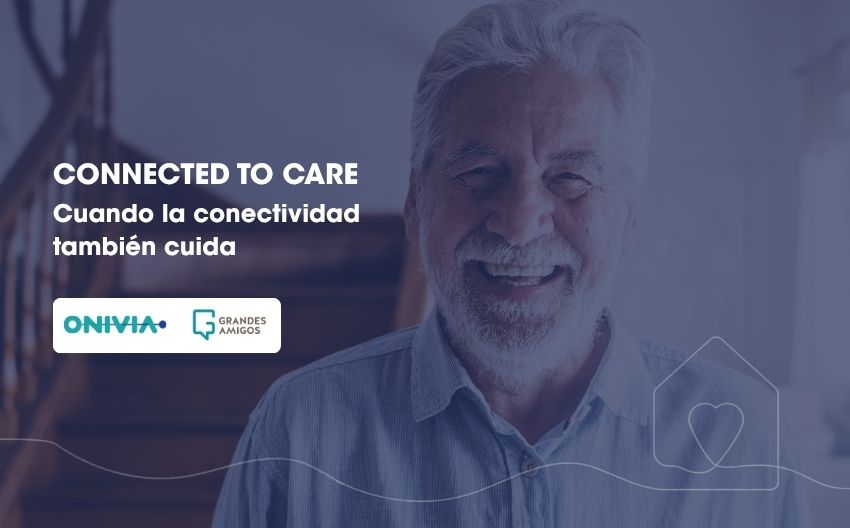
Spain is facing a profound demographic shift. People are living longer, but the number of older adults living alone is also increasing. Today, millions of people manage their daily lives without continuous companionship, facing risks related to safety, health, and social isolation.
In this context, the challenge is no longer only about living longer, but about living better. And above all, about being able to do so at home.
Connected to Care was created to explore how technology can be used in practical ways to improve the lives of older adults who wish to live independently.
- The challenge we are addressing
Many older adults want to remain in their homes, but they often need more support than is currently available:
- a fall may go unnoticed for hours
- changes in daily routines can be early signs of health issues
- lack of regular contact can increase feelings of isolation
Connected to Care addresses this balance: how to provide better support without being physically present at all times and without invading privacy.
- How it works in practice
The project builds on a device already present in most homes: the router.
Using household WiFi signals combined with artificial intelligence, the system progressively learns typical activity patterns within the home and can detect meaningful deviations, such as unusual periods of inactivity or changes in daily habits.
When an unexpected situation is identified, alerts can be sent to family members, caregivers or support networks, enabling faster intervention when needed.
This approach moves from occasional monitoring to a continuous understanding of everyday activity through a non-intrusive model that adapts to each individual.
- Technology combined with social support
Connected to Care is driven by Onivia and the Fundación Grandes Amigos, ntegrating two key dimensions: the technological layer and the human layer of social companionship.
The result is a more comprehensive model in which technology does not replace people, but strengthens their ability to care.
The project, currently under development, will be implemented through a pilot in real households to validate an approach that enables scaling this type of solution while maintaining its usefulness in everyday life. The initiative has also been recognised by the Macquarie Group Foundation, which has awarded funding through its international programme supporting community-focused social impact initiatives in the regions where the Group operates, reinforcing its value as an innovative use case of connectivity applied to care at home.
- Social Impact and alignment with the 2030 Agenda
Connected to Care contributes to improving safety at home, strengthening personal autonomy, reducing unwanted loneliness and supporting digital inclusion.
The initiative also aligns with several United Nations Sustainable Development Goals:
SDG 3: Good Health and Well-being
SDG 9: Industry, Innovation and Infrastructure
SDG 10: Reduced Inequalities
SDG 11: Sustainable Cities and Communities
SDG 17: Partnerships for the Goals
This approach positions digital infrastructure as a key enabler for developing scalable and sustainable social solutions capable of addressing one of today’s most significant demographic challenges.